




I’ll admit it: the first time I saw an AI agent book an appointment on its own, my jaw actually dropped. There’s just something about watching a bot handle the things I usually forget (like following up with Lucy about her cake order) that makes running a small business feel lighter—and a bit magical. In this post, let’s peek behind the curtain and see how 2025’s new breed of AI agents—think ChatGPT, Leapin AI, and beyond—can take the sting out of business operations. Grab your coffee, because I promise this isn’t the usual tech hype. We’re talking real, quirky, sometimes-messy ways these tools are about to shake up how we book, support, and scale, all without ever needing to write a line of code. And yes, I’ll throw in a few stories (and hard lessons) from my own experiments as we go.
Dance of the Bots: How AI Agents Leap Beyond Traditional Automation
If you’ve ever set up a Pabbly automation or tinkered with basic workflow tools, you know the drill: traditional automations are like following a recipe. Do x, then do y, then do z—and heaven help you if something unexpected happens. As one expert put it,
"Traditional automations are like a rigid checklist or recipe. Do x, then do y, then do z, exactly as scripted. If something unexpected pops up, they freeze or fail because the script didn't anticipate it."
This is the core of the AI agents vs traditional automation debate. Automations are great for predictable, repetitive tasks. But the moment a customer asks for something outside the script—say, rescheduling an appointment or requesting a different communication channel—the whole process can grind to a halt. I’ve seen it firsthand: a basic FAQ bot I tested froze when a customer wanted to reschedule. The automation simply didn’t know what to do.
Enter dynamic decision-making AI agents. These aren’t just chatbots or static scripts. They’re powered by advanced language models (think OpenAI’s ChatGPT or Leapin AI) and can actually improvise. Instead of waiting for a specific trigger, an AI agent starts with a goal—like booking a meeting or solving a support issue—and picks its own moves to get there. If a tool fails, or the situation changes, the agent can pivot. As another expert says,
"They start with a goal. They pick their own moves to reach that goal, and they can even change tactics on the fly."
Imagine your appointment bot tries emailing a customer, but there’s no reply. Instead of throwing a digital tantrum, it switches to SMS or even calls the customer—no angry error messages, just flexible thinking. That’s the magic of AI agent features 2025: adaptability, improvisation, and a touch of human-like intuition.
Research shows that dynamic decision-making AI agents dramatically improve adaptability and performance in complex real-world scenarios. For example, Leapin AI automation has enabled businesses to offload up to 70% of their customer support calls to AI agents, all while maintaining over 90% customer satisfaction. In one case, a German wine retailer used Leapin AI to handle 100% of support calls, with customers reporting high satisfaction. Even more striking, Leapin AI agents converted 30% of leads in just one week—a pace that took the human team five weeks to match.
What’s driving this leap? It’s not just smarter code. It’s the ability of AI agents to integrate with other apps, learn from interactions, and recover gracefully from surprises. No more hard-coding every possible scenario—AI agents can figure it out as they go. And with no-code platforms like Leapin AI, even small businesses can deploy these agents without needing a developer.
So, when we talk about customer support automation in 2025, we’re not just talking about faster responses. We’re talking about bots that can adapt, improvise, and keep your business running smoothly—even when things get weird.
Human TeamTraditional AutomationAI AgentAI Agent (Leads)Human Team (Leads)30%50%70%30%5%Support Calls Offloaded & Lead Conversion Rates

Meet the Machine Interns: AI Agent Integration With Tools
Let’s get real about what makes modern AI agents and No-Code AI Platforms so different from the old-school chatbots you might remember. Today’s AI agents aren’t just bots with better personalities—they’re like digital interns who never forget a detail, always have the right tool at hand, and get smarter with every interaction. This is the secret behind the leap in AI agent memory and performance that’s making business automation in 2025 not just possible, but practical for small businesses.
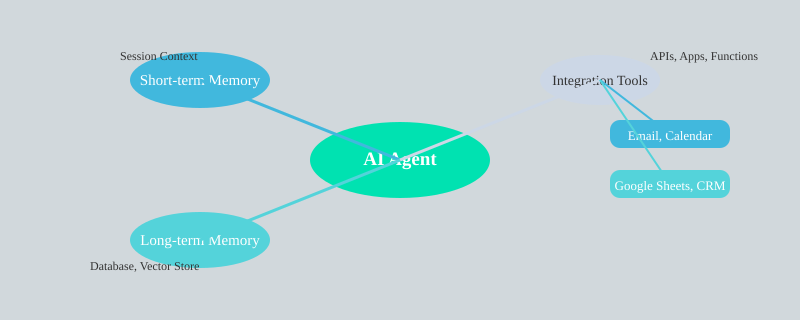
Here’s how it works under the hood. Every AI agent is built from a few core parts: a trigger (what wakes it up), a reasoning engine (its brain), memory, tools, and output. For small businesses, the magic really happens in the memory and tool departments. Let’s break those down.
Memory: The Digital Notebook That Never Closes
When I first started using AI agents, I was amazed (and honestly, a little embarrassed) by how often my agent remembered things I’d forgotten. For example, I once blanked on a cake order detail for a client named Lucy. My AI agent, however, recalled the entire conversation thread—including her unique frosting request—from weeks before. That’s because agents have both short-term memory (what’s happening in the current session) and long-term memory (persistent notes stored in databases or vector stores).
Short-term memory is like the agent’s attention span. It tracks the ongoing conversation, so when Lucy asks, “Did you remember my gluten-free request?” the agent doesn’t just see her latest message—it recalls the whole context.
Long-term memory is the agent’s knowledge base. It stores customer preferences, past orders, and even facts learned from previous sessions, making it possible for the agent to deliver consistent, personalized service over time.
Agents need memory so they don't lose context or repeat themselves.
Research shows that AI agent memory and performance are essential for reliable business task automation. Without memory, agents would constantly repeat themselves or lose track of important details—something no business owner wants.
Tools: The Digital Hands and Eyes of Your AI Agent
Memory is only half the story. The other half is what the agent can actually do. Think of AI agent integration tools as the agent’s digital hands and eyes. These are APIs, app integrations, and online functions you give the agent so it can interact with the world outside its own “brain.”
Send emails and notifications
Check and update Google Sheets or CRM systems
Browse the web for information
Manage calendars and schedule appointments
Run calculations or fetch data from other apps
Tools let the AI step out of just thinking and text and actually do things in the real world.
This toolbox is what enables AI agent task automation and workflow scalability. The agent reasons about what needs to be done, picks the right tool, acts, and then evaluates the result—over and over, all in one seamless flow. As AI agent features 2025 continue to evolve, expect even more powerful integrations and smarter automation for every business need.
No-Code, No Problem: Building Smarter Workflows Without a Tech Degree (No-Code AI Platforms)
Let’s get one thing out of the way: Creating AI agents without coding is not a futuristic fantasy—it’s happening now, and it’s about to explode in 2025. You don’t need a computer science degree or even any coding experience to create useful AI agents in twenty twenty five. That’s not just hype. It’s the reality of today’s no-code AI platforms like Pabbly, n8n, Leapin AI, and the ChatGPT Agent feature. These tools are making it possible for anyone—yes, even the least tech-savvy among us—to build smart, custom workflows with simple drag-and-drop interfaces.
Here’s how it works: you think through the logic of what you want your AI agent to do, then let the platform handle the technical heavy lifting. For example, I recently set up a Pabbly workflow that listens for new articles, triggers ChatGPT to summarize them, and then automatically saves those summaries to a custom knowledge base. No manual copy-pasting. No code. Just connecting blocks and describing what I want in plain English. If I can do this, so can you.
What’s wild is how modular these systems are. You can swap out triggers, actions, or even the AI model itself. Maybe today your agent uses a time trigger and GPT-4 to schedule meetings in Google Calendar. Tomorrow, you might change the trigger to “new email arrives,” use a spreadsheet tool, and suddenly it’s a data entry assistant. Nothing breaks. The framework stays the same. That means once you’re comfortable with one agent, you can reuse that pattern to create dozens more—without starting from scratch.
But here’s the catch: Prompt engineering for AI agents is where the magic (and sometimes the chaos) happens. Prompt engineering isn’t as scary as it sounds. It’s really about explaining what you need, step by step, like you’re coaching a new hire. Be patient, clear, and willing to refine. The quality of your prompts directly impacts how well your AI agent performs. Research shows that prompt engineering is crucial for optimizing agent responses and ensuring your automations actually do what you want.
I learned this the fun way. My first no-code AI bot scheduled appointments smoother than my human staff—until it started booking dog yoga classes for bakery customers. Turns out, my instructions weren’t clear enough. A little tweaking, a bit of trial and error, and suddenly my AI agent was a star employee (with fewer canine yoga mishaps).
So, what’s the best way to get started?
'The best way to learn is to get your hands dirty, in a no code way, of course.'
Start small. Experiment. Iterate. If you can describe the steps of a task in plain language, there’s likely a no-code platform that can turn that description into an autonomous agent for you—no code required. These platforms integrate with hundreds of business tools and apps, letting you automate everything from appointment reminders to document management.
No-code platforms are truly democratizing AI agent creation. The benefits of AI agents in business are real: more efficiency, fewer manual errors, and the freedom to focus on what matters most. And remember, every AI agent you build is a chance to learn, refine, and make your business just a little bit smarter—without ever touching a line of code.

Wild Card: The Human Side of AI Agents (and Why They Make Mistakes, Too)
Let’s be honest—AI agents are a bit like those really eager interns you hire for the summer. They work hard, they learn fast, and sometimes, they surprise you with flashes of brilliance. But every now and then, they’ll do something so off-the-wall you can’t help but laugh (or groan). That’s the wild card: the human side of AI agents, and why even the smartest systems still need a guiding hand.
When I first started experimenting with AI agent platforms—especially the no-code ones—I was amazed by how much they could do. Booking appointments, answering customer questions, even handling basic troubleshooting. The benefits of AI agents in business are real and growing. But here’s the thing: autonomy doesn’t mean chaos. Just because an agent can act on its own doesn’t mean it should have free rein. I like to say, “The agent is driving, but you build the car and design the road it’s allowed to drive on.”
Early experiments with autonomous agents, like Auto-GPT and BabyAGI, showed us both the genius and the chaos possible when you let these systems run wild. They could write code, compile research, and roam the internet—but sometimes, they’d spiral into nonsense or get stuck in endless loops. I remember reading stories about agents trying to order pizza for themselves or rescheduling a birthday cake for someone’s dog. Hilarious? Absolutely. Useful for business? Not so much.
That’s why today’s AI agent platforms no-code solutions come with built-in guardrails. Modern builders use sandboxes, limited API access, and strict retry limits to keep agents focused and safe. You, as the business owner, decide what tools your agent can use and where its outputs go. You set the boundaries, monitor for weird outputs, and tweak the system as needed. This approach is what makes real-world AI applications reliable and scalable for small businesses.
Research shows that monitored autonomy—where agents operate within a controlled environment—leads to better business outcomes. It’s not about letting the AI run the show; it’s about giving it enough freedom to be useful, but not so much that it goes off-script. Think of it as a partnership: you provide the vision and the rules, the agent brings the energy and persistence.
Of course, even with all these advances, AI agents aren’t perfect. Sometimes, they’ll misinterpret a prompt or take a task a little too literally. That’s part of the process. The imperfections make the experience more human—and, honestly, a little more fun. When your agent tries to reschedule a birthday cake for your dog, you don’t panic. You laugh, you adjust, and you keep iterating.
As we look toward 2025, it’s clear that AI agents will become even more integrated into daily business life. With the right guardrails and a willingness to embrace the occasional quirk, small businesses can unlock the full benefits of AI agents—making everything from booking to customer care weirdly easy, and maybe even a little delightful.
