
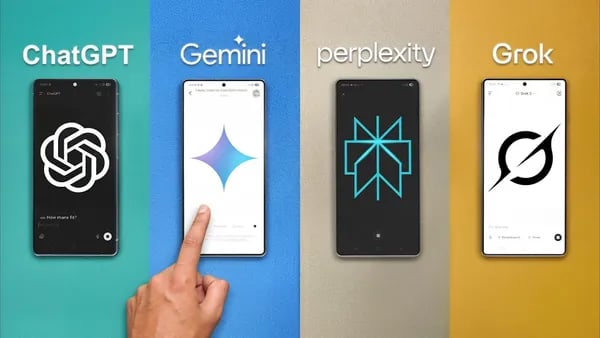



Let me let you in on a secret—when I started using AI chatbots for my own side hustle, I expected magic. What I got was...well, a maze of endless chatbot options and conflicting advice! If you’ve ever been paralyzed trying to pick between ChatGPT, Google Gemini, Perplexity, or the (slightly rogue) Grok, you’re not alone. And if you run a small business? The stakes feel even higher. Today, let's bust through the sales pitch and figure out firsthand what these bots can actually do for you, your customers, and your to-do list—with a few unexpected lessons along the way.
Best AI Chatbots 2025: AI Models Put to the Test
When you’re searching for the best AI chatbots 2025 has to offer, four names stand out: ChatGPT, Google Gemini, Perplexity, and Grok. Each claims to deliver top-tier AI chatbot accuracy speed and problem-solving skills. But how do they really perform when you throw real-world tasks their way—especially those that matter most for small businesses, like booking, product recommendations, and customer service?
Let’s break down what happened when these chatbots faced practical scenarios:
ChatGPT: Known for its conversational style and multiple pricing tiers, including Plus and Enterprise. It handled most tasks well, but sometimes hesitated with product specifics.
Google Gemini: Fast and confident, but occasionally invented products—like recommending non-existent red earbuds. Not ideal if you need reliable suggestions.
Perplexity: Markets itself on trusted answers, yet sometimes missed the mark, like overestimating luggage capacity or confusing cake ingredients with coffee.
Grok: Trained on X data, Grok was direct and accurate in several cases—especially when identifying tricky items or giving clear, actionable answers.
For small businesses, these differences matter. Operations, booking, and service all rely on AI chatbot problem-solving and accuracy. Research shows that even the best bots can confidently give plausible, but wrong, answers. None handled every task flawlessly—sometimes, you get a surprise, like mushrooms mistaken for coffee!
Test Scenario | Key Finding |
|---|---|
Honda Civic 2017 trunk | Max 2 suitcases fit; only Grok gave the correct answer confidently |
Product Recommendation | Gemini failed to suggest real red earbuds |
Translation & Reasoning | Chatbots scored 4-5/5 in nuanced language tasks |
Mario Kart Score Sheet | All understood, none created an editable document |
"I realize now while I was off exploring a fantasy world, I was missing out on the most important real one."
Pricing Models: What You’ll Actually Pay
When you start looking into AI chatbot pricing in 2025, you’ll notice a huge range in what you might pay. For small businesses, most chatbot subscription plans start as low as $15 per month and can climb to $500 per month, depending on the features you need. If you’re running a larger operation or need enterprise chatbot solutions—especially in regulated industries like healthcare or finance—costs can soar from $200,000 to over $1 million annually. As one industry expert puts it:
"AI chatbot pricing in 2025 varies widely from $15/month for small business plans to over $1 million for complex enterprise solutions depending on features and compliance needs."
So, what do you actually get for your money? The gap between free and paid chatbot subscription cost is mostly about access to advanced tools. Free versions usually cover basic Q&A and simple automation. Paid plans, however, unlock analytics, integration with your other business tools, and real-time features. For example, ChatGPT now offers Plus, Team, and Enterprise tiers, each with increasing levels of capability and support.
But the cost doesn’t just come from the subscription itself. Several chatbot cost factors can crank up your bill:
Number of users: More users or customer interactions often mean higher costs.
Integration depth: Connecting your chatbot to CRMs, payment systems, or custom apps adds complexity.
Compliance needs: Industries with strict data rules (like banking) require extra security, which drives up pricing.
Research shows that AI chatbots can reduce customer service costs by 40-60%, but only if you choose the right plan for your needs. Subscription models now include usage-based and hybrid options, so you can tailor your investment.
Plan Type | Typical Monthly Cost | Key Features |
|---|---|---|
Small Business | $15–$500 | Basic automation, limited integrations |
Enterprise | $16,700–$83,000+ | Advanced features, compliance, custom integrations |
Reality Check: Where These Bots Shine (and Fail) for Small Business
When it comes to AI chatbot problem-solving for small businesses, the reality is more complicated than the marketing hype suggests. Real-world tests show that these bots can be both surprisingly helpful and unexpectedly unreliable, depending on the scenario.
Take translation, for example. In a test with native Spanish speakers, both ChatGPT and Perplexity handled a nuanced sentence well, while Gemini barely scraped by and Grok’s translation was too literal to make sense. So, for customer care or bookings in multiple languages, some bots clearly outperform others.
But when you turn to AI chatbot product recommendations, things get messy. In a simple earbud search, ChatGPT, Perplexity, and Grok all recommended real, popular models. Gemini, on the other hand, confidently invented a product that doesn’t exist. Even more confusing, when asked for red earbuds, only Grok found options that were actually red—while others offered pink or ignored the color entirely. As one tester put it:
"The problem is that it gives you wrong answers with the exact same level of certainty as it gives you right answers."
This highlights a core issue with fact-checking AI chatbots: they can improvise or misinterpret context, especially when faced with unknowns. In pricing tests, Perplexity even claimed a $40 product cost $9.99, showing that accuracy claims are often misleading. Always verify before relying on AI alone.
Speed is another factor in the AI chatbot speed comparison, but faster answers aren’t always better. Sometimes, the quickest response is also the most inaccurate. In critical thinking scenarios—like identifying spurious correlations—some bots (like Gemini and Perplexity) spotted the logical trap, while others failed.
Research shows that while AI chatbots offer value, especially for routine queries, deep integrations and reliable product research remain a work in progress. For now, the best value AI chatbot 2025 is the one that balances speed, accuracy, and transparency—without pretending to know it all.
Integration, Customization, and the Unexpected: Making Bots Work for You
When you look past the marketing buzz, AI chatbot integrations in 2025 are a mixed bag—especially for small businesses. You might expect seamless connections to your booking tools or CRM, but in reality, true “plug-and-play” is still rare. Most leading bots can handle basic requests, like summarizing a document or generating a quick itinerary. In fact, research shows that ChatGPT and Grok now deliver structured, useful outputs for itinerary and idea generation, while others like Perplexity still lag behind. But when you ask these bots to generate editable documents you can use right away, disappointment is common. All the major chatbots tested could create basic templates, but none produced ready-to-download files. As one user put it,
"I feel like with these kinds of responses, it would be easier for me to just whip up a spreadsheet on my own."
This gap highlights a key challenge in AI chatbot real-world applications: flexibility. Bots are getting smarter at memory recall and can summarize uploaded files with ease, but integrating with external links or pulling detailed product info from sites like AliExpress remains out of reach. For small businesses, this means that while AI chatbot problem-solving scenarios are expanding, you’ll still need patience—and sometimes a clever workaround—to get the most out of these tools.
Subscription plans for AI chatbots now range from affordable monthly options for small teams to enterprise-level solutions with hefty price tags. Yet, the real value comes down to how well a bot fits your workflow. If your business relies on custom processes or unique integrations, you may find that automation only goes so far. In 2025, the most successful small businesses will be those that blend AI chatbot integrations with a healthy dose of human creativity and adaptability. Sometimes, the best solution is still the simplest one you create yourself.
______________________________________________________________________________________________________________________________________
If you are a business owner and want to start using AI to transform your business, a simple way is to use AI chatbots for your website or funnel sales page. If you don't have time and want help in implementing this quick solutions reach out to me and I will gladly schedule time to help. Click here to schedule: https://cme.sh/Book-Now
